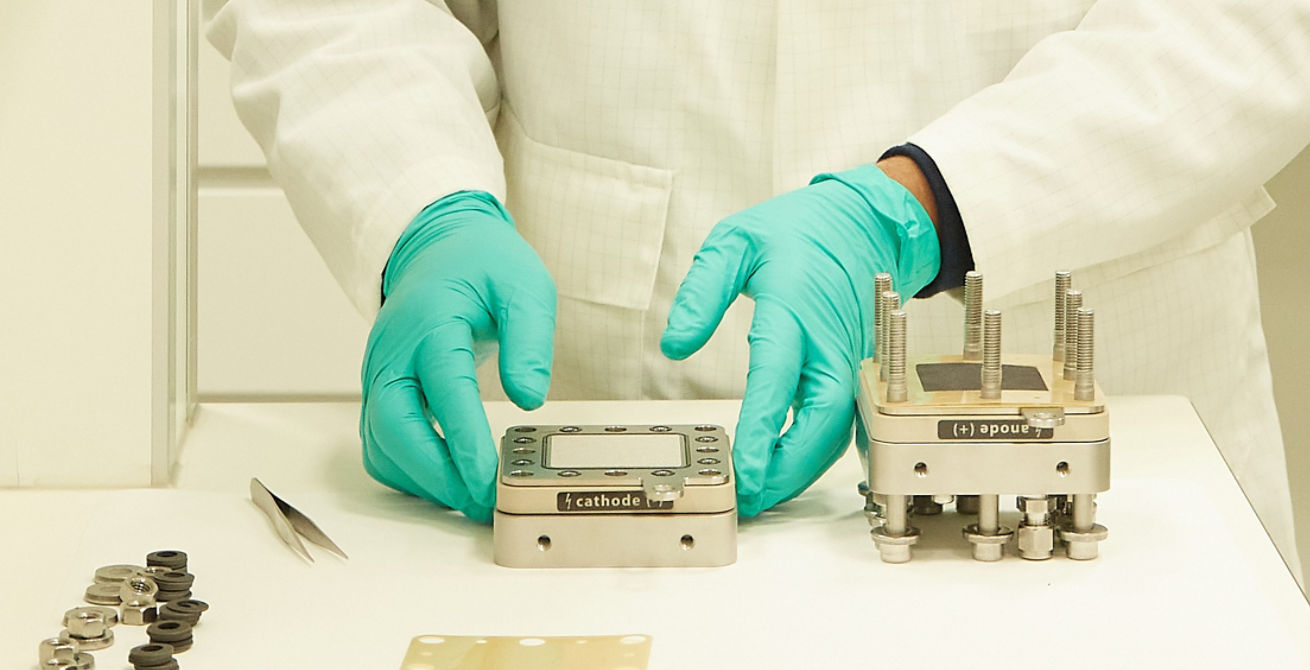


You can cut our materials via laser cutting with the required safety measures to prevent fires (as Titanium is extremely flammable).
Mechanical cutting is possible if the tolerances can meet your requirements.
Titanium provides ideal performance in the highly oxygenated environments of PEM. Our titanium PTL (Porous Transport Layer) features better electrical potential than other metals. The inherent characteristics of titanium ensure longevity over the life of the PTL. It is well-suited to low pH, and imparts oxidation and corrosion resistance, as well as structural integrity. It's proven history of stability makes titanium the PTL material of choice for your next PEM design.
The low pH, acidic environment of PEM contributes to an added oxide layer buildup. Over time, this leads to component degradation. While titanium fiber alone is prone to buildup, a thin platinum coating can make a difference. Learn more about our Pt coated titanium PTL.
The hydrogen production process depends upon optimal catalyst activity. This involves nearly complete contact between all active areas in the catalyst layer and the PTL. Doing so enables an ideal electrical connection to establish between the two. As such, the pores of the PTL should be small and even, with a smooth surface area. A platinum coating improves interface characteristics by more homogeneous current distributions.
Image source: Paul Scherrer Institut, Tobias Schuler et al 2019 J. Electrochem. Soc. 166 F270
Sintered metal fiber media have pore sizes in the µm-range
How can the material be cut? What cutting technologies can be used?

You can cut our materials via laser cutting with the required safety measures to prevent fires (as Titanium is extremely flammable).
Mechanical cutting is possible if the tolerances can meet your requirements.
What is the grade of the materials being used?
Grade 1
What are the tolerances on dimensions, length, width and thickness?
The standard tolerances which are applicable to the dimensions of our sample materials: ± 4mm.
For commercial projects, we have custom cutting technologies with tolerances of ± 0,5 mm and a thickness tolerance of ± 10%.
What product dimensions are available?
Limiting to standard products:
You can request a quote on our website.
Larger and custom sizes are available for industrial quantities. Please contact us with your questions.
Can you explain your product codes?
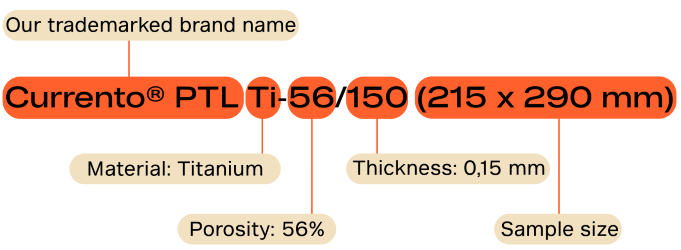

What is the new name of the materials I have ordered in the past?
We've changed our material codes in 2024. If you're looking for the old material codes, you can find them in this table, together with the new material codes.
You can request a quote on our website.
| Material Code (before 2024) | Material Code (2024) | Thickness | Thickness | Porosity | Surface Area | |
|---|---|---|---|---|---|---|
| Currento® 2NI 06-0,100 | Currento® PTL Ni-66/100 (215 x 290 mm) | 0,10 mm | 0.004 inch | 66% | Normal | |
| Currento® PTL Ni-66/100 (430 x 580 mm) | ||||||
| Currento® 2NI 06-0,200 | Currento® PTL Ni-83/200 (215 x 290 mm) | 0,20 mm | 0.008 inch | 83% | ||
| Currento® PTL Ni-83/200 (430 x 580 mm) | ||||||
| Currento® 2NI 18-0,250 | Currento® PTL Ni-60/250 (215 x 290 mm) | 0,25 mm | 0.010 inch | 60% | ||
| Currento® PTL Ni-60/250 (430 x 580 mm) | ||||||
| Currento® 2NI 30-0,500 | Currento® PTL Ni-66/500 (215 x 290 mm) | 0,50 mm | 0.020 inch | 66% | ||
| Currento® PTL Ni-66/500 (430 x 580 mm) | ||||||
| Currento® 2NI 18-0,500 | Currento® PTL Ni-80/500 (215 x 290 mm) | 80% | ||||
| Currento® PTL Ni-80/500 (430 x 580 mm) | ||||||
| Currento® 2NI 30-1,000 | Currento® PTL Ni-83/1000 (215 x 290 mm) | 1,00 mm | 0.039 inch | 83% | ||
| Currento® PTL Ni-83/1000 (430 x 580 mm) | ||||||
| - | Currento® PTL INC 79/600 (210 x 297 mm) | 0,60 mm | 0.024 inch | 79% | Medium | |
| Currento® PTL INC 79/600 (430 x 580 mm) | ||||||
| - | Currento® PTL NI HR 78/300 (210 x 297 mm) | 0,30 mm | 0.012 inch | 78% | High | |
| Currento® PTL NI HR 78/300 (430 x 580 mm) | ||||||
| - | Currento® PTL NI HR 82/500 (210 x 297 mm) | 0,50 mm | 0.020 inch | 82% | ||
| Currento® PTL NI HR 82/500 (430 x 580 mm) | ||||||
| - | Currento® PTL INC 82/500 (210 x 297 mm) | |||||
| Currento® PTL INC 82/500 (430 x 580 mm) | ||||||
| Currento® 60 BL3 | Currento® PTL SS-74/145 (210 x 297 mm) | 0,15 mm | 0.006 inch | 74% | Normal | |
| Currento® PTL SS-74/145 (430 x 580 mm) | ||||||
| - | Currento® PTL SS-85/1000 (210 x 297 mm) | 1,00 mm | 0.039 inch | 85% | ||
| Currento® PTL SS-85/1000 (430 x 580 mm) | ||||||
| Currento® 20 AL3 | Currento® PTL SS-82/500 (210 x 297 mm) | 0,50 mm | 0.020 inch | 82% | Medium | |
| Currento® PTL SS-82/500 (430 x 580 mm) | ||||||
| Currento® 10 BL3 | Currento® PTL SS-81/200 (210 x 297 mm) | 0,20 mm | 0.008 inch | 81% | High | |
| Currento® PTL SS-81/200 (430 x 580 mm) | ||||||
| Currento® 10 FP3 | Currento® PTL SS-71/260 (210 x 297 mm) | 0,26 mm | 0.010 inch | 71% | ||
| Currento® PTL SS-71/260 (430 x 580 mm) | ||||||
| Currento® 10 AL3 | Currento® PTL SS-78/300 (210 x 297 mm) | 0,30 mm | 0.012 inch | 78% | ||
| Currento® PTL SS-78/300 (430 x 580 mm) | ||||||
| - | Currento® PTL SS-62/410 (210 x 297 mm) | 0,41 mm | 0.016 inch | 62% | ||
| Currento® PTL SS-62/410 (430 x 580 mm) | ||||||
| Currento® 2GDL6-0,150 | Currento® PTL Ti-56/150 (215 x 290 mm) | 0,15 mm | 0.006 inch | 56% | Normal | |
| Currento® PTL Ti-56/150 (430 x 580 mm) | ||||||
| Currento® 2GDL10-0,250 | Currento® PTL Ti-56/250 (215 x 290 mm) | 0,25 mm | 0.010 inch | |||
| Currento® PTL Ti-56/250 (430 x 580 mm) | ||||||
| Currento® 2GDL20-0,500 | Currento® PTL Ti-56/500 (215 x 290 mm) | 0,50 mm | 0.020 inch | |||
| Currento® PTL Ti-56/500 (430 x 580 mm) | ||||||
| Currento® 2GDL20-1,000 | Currento® PTL Ti-56/1000 (215 x 290 mm) | 1,00 mm | 0.039 inch | |||
| Currento® PTL Ti-56/1000 (430 x 580 mm) | ||||||
| - | Currento® PTL Ti-66/200 (215 x 290 mm) | 0,20 mm | 0.008 inch | 66% | ||
| Currento® PTL Ti-66/200 (430 x 580 mm) | ||||||
| - | Currento® PTL Ti-67/200 (215 x 290 mm) | 0,20 mm | 0.008 inch | 67% | ||
| Currento® PTL Ti-67/200 (430 x 580 mm) | ||||||
| - | Currento® PTL Ti-68/350 (215 x 290 mm) | 0,35 mm | 0.014 inch | 68% | ||
| Currento® PTL Ti-68/350 (430 x 580 mm) | ||||||
| - | Currento® PTL Ti-70/750 (215 x 290 mm) | 0,75 mm | 0.030 inch | 70% | ||
| Currento® PTL Ti-70/750 (430 x 580 mm) | ||||||
| - | Currento® PTL Ti-77/2000 (215 x 290 mm) | 2,00 mm | 0.079 inch | 77% | ||
| Currento® PTL Ti-77/2000 (430 x 580 mm) | ||||||
| - | Currento® PTL Ti-78/2000 (215 x 290 mm) | 2,00 mm | 0.079 inch | 78% | ||
| Currento® PTL Ti-78/2000 (430 x 580 mm) | ||||||
| No separate material code existed | Currento® PTL Ti-56/150 PT200 (220 x 290 mm) | 0,15 mm | 0.006 inch | 56% | Normal | |
| Currento® PTL Ti-56/150 PT200 (440 x 550 mm) | ||||||
| Currento® PTL Ti-56/250 PT200 (220 x 290 mm) | 0,25 mm | 0.010 inch | ||||
| Currento® PTL Ti-56/250 PT200 (440 x 550 mm) | ||||||
| Currento® PTL Ti-56/500 PT200 (220 x 290 mm) | 0,50 mm | 0.020 inch | ||||
| Currento® PTL Ti-56/500 PT200 (440 x 550 mm) |
Navigate to our general and common questions on our product capabilities.