

Limiting to standard products:
- 210 x 290 mm
- 430 x 580 mm
You can request a quote on our website.
Larger and custom sizes are available for industrial quantities. Please contact us with your questions.
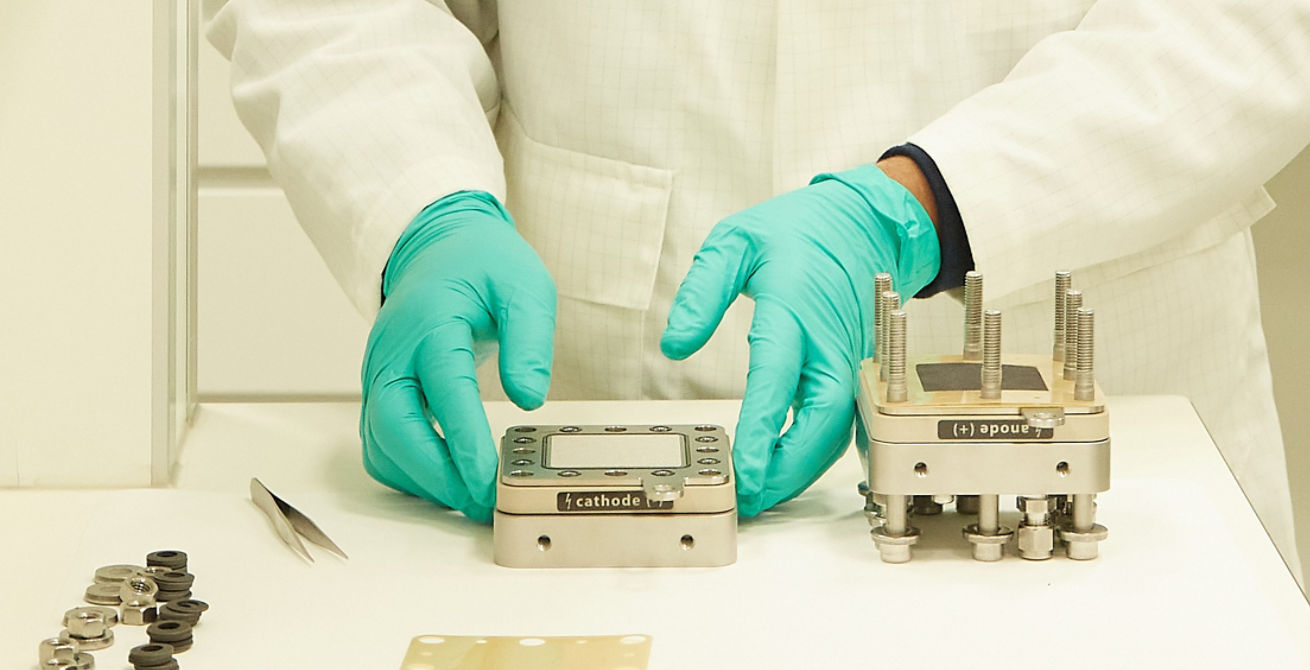
Green hydrogen starts with smart materials. At the core of hydrogen production is a component often overlooked, yet absolutely critical: the Porous Transport Layer (PTL). In PEM and AEM electrolyzers, the PTL sits between the catalyst layer and the flow field. This porous, metallic structure plays a pivotal role in optimizing the performance, efficiency, and durability of the electrolyzer. A high-performance PTL supports efficient water electrolysis by:
Efficient porton transport
PEM, or proton exchange membranes, enable hydrogen ions to flow from the anode to the cathode, driving reliable electrolyzer performance. This thin layer separates electrodes while supporting power applications from transportation to stationary energy systems.
Cost-efficient performance
AEM, or anion exchange membranes, enable hydrogen production using hydroxide ion transport in alkaline environments. AEM technology reduces corrosion risk, supports the use of low-cost metals, and shows strong potential for producing renewable hydrogen at lower costs.
Our new white paper explores the advantages of metal fiber media for water electrolysis applications. From flexibility to porosity and even efficient mass transport, there's a lot to learn about our porous transport layers (PTLs).
What product dimensions are available?

Limiting to standard products:
You can request a quote on our website.
Larger and custom sizes are available for industrial quantities. Please contact us with your questions.
What is the lowest porosity which Bekaert can supply?
We can provide a minimum porosity of 45%
Can the thickness be adapted to fit the cell design?
Our standard portfolio is available in the following thickness range:
You can request a quote on our website.
For commercial projects the thickness can be adapted, but this will have an impact on porosity.
Is there any specifications on pore size?
We are currently working on basic characterisations of porous structures to determine pore size. This will allow definitions of minimum, average and maximum pore sizes.
Fiber structures are 3-dimensional labyrinth structures and the smallest part of the pore size can be in the depth. This is less relevant for the PTL performance in electrolysis.
More valuable data for the pore sizes at the surface (top 20 µm) can be collected via µCT scans which are quite sophisticated and expensive. Pore size specifications will become available for an increasing section of our product portfolio.
Is there a technical data sheet available?
We provide a product list with the parameters indicated in the product types. We are currently collecting technical data to complete set of data, which can be already available upon request for selected products.
Is there a Safety Data Sheet (SDS) available?
We have no Safety Data Sheet available. Our products are not chemicals but articles. REACH explicitly defines that SDS is relevant to chemicals only, and legal authorities recommend not to issue SDS's for articles.
How can the material be cut? What cutting technologies can be used?
You can cut our materials via laser cutting with the required safety measures to prevent fires. Mechanical cutting is possible if the tolerances can meet your requirements.
Do your products have a top and bottom side?
Our monolayer materials do not have a top and bottom side.
Our dual layer materials have a fine toplayer (usually facing the MEA/CCM side) and a coarse backlayer (facing the Bipolar Plate side).

What are the tolerances on dimensions, length, width and thickness?
The standard tolerances which are applicable to the dimensions of our sample materials: ± 4mm.
For commercial projects, we have custom cutting technologies with tolerances of ± 0,5 mm and a thickness tolerance of ± 10%.
Navigate to our general and common questions on our product capabilities.